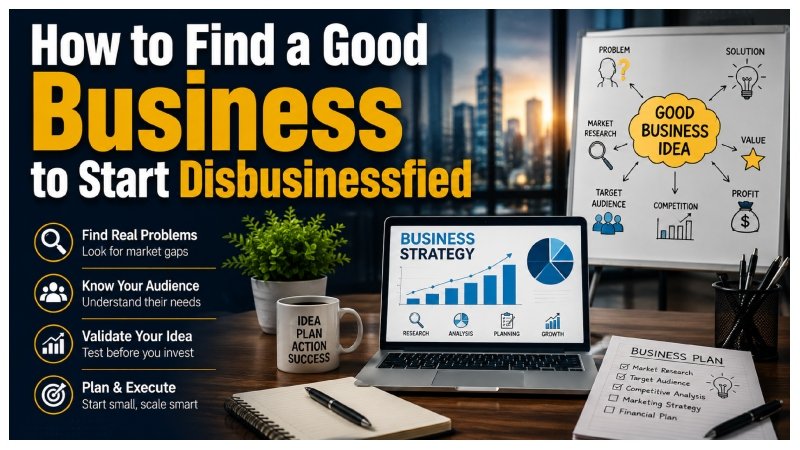
Starting a business can change your financial future, but choosing the wrong business idea can waste valuable time, money, and energy. Many aspiring entrepreneurs spend months searching for the perfect opportunity, only to become overwhelmed by endless options and conflicting advice. The reality is that successful businesses rarely begin with luck. They start with research, planning, and a clear understanding of market demand. If you’re searching for how to find a good business to start disbusinessfied, you’re likely looking for a practical framework that helps you identify profitable opportunities instead of relying on guesswork.
This guide provides exactly that. You’ll learn how to evaluate business ideas, understand customer needs, analyze competition, validate demand, and build a strong foundation for long-term success. Whether you’re launching your first venture or looking for a new opportunity, these principles can help you make smarter decisions and avoid costly mistakes.
Understanding How to Find a Good Business to Start Disbusinessfied
Finding the right business opportunity is one of the most important decisions an entrepreneur can make. Many people spend months searching for a profitable business opportunity but end up choosing ideas based on trends rather than real market demand. The truth is that a successful business opportunity is rarely about finding something completely new. Instead, it is about identifying a problem that people are willing to pay to solve and creating a better solution than existing competitors.
When learning how to find a good business to start disbusinessfied, it helps to focus on opportunities that combine customer demand, profitability, and long-term growth potential. A strong business opportunity should solve a real problem, serve a specific audience, and provide value that customers recognize and appreciate. The more clearly you understand the market, the easier it becomes to identify a business opportunity that can generate sustainable revenue and grow over time.
Rather than chasing every new trend, successful entrepreneurs evaluate each business opportunity carefully. They study customer behavior, analyze competitors, and validate demand before investing significant time or money. This approach reduces risk and increases the chances of building a profitable and sustainable venture.
Why Most People Choose the Wrong Business
Before discussing what works, it is important to understand what doesn’t.
Many beginners fail because they:
- Follow trends without research
- Copy competitors without adding value
- Start businesses based solely on passion
- Ignore customer feedback
- Invest too much money too early
- Skip market validation
For example, someone may see a trending online business and assume it is profitable. However, by the time they enter the market, competition may already be intense.
Successful entrepreneurs do not chase every opportunity. They evaluate opportunities carefully and choose ideas supported by evidence.
Start With Problems Instead of Products
One of the most effective methods for discovering business opportunities is identifying problems people face regularly.
Ask yourself:
- What frustrates people?
- What tasks consume too much time?
- What services receive constant complaints?
- What products fail to meet expectations?
Every problem creates potential demand for a solution.
Consider these examples:
| Problem | Business Opportunity |
|---|---|
| Busy professionals lack time | Virtual assistant services |
| Small businesses need customers | Marketing services |
| Students need academic support | Tutoring business |
| Homeowners need repairs | Home maintenance services |
| Businesses need online presence | Website development |
The larger and more common the problem, the greater the opportunity.
Research Existing Market Demand
A business idea should never rely on assumptions.
Before investing money or time, confirm that people are already spending money within that market.
Research demand by exploring:
Online Marketplaces
Popular marketplaces reveal what customers actively purchase and what products or services remain in demand.
Industry Forums and Communities
Online communities often highlight customer frustrations, unmet needs, and emerging trends.
Local Business Activity
Observe businesses in your area. Consistent customer traffic usually indicates stable demand.
Customer Reviews
Reviews reveal exactly what customers appreciate and what they dislike about existing solutions.
Understanding demand helps eliminate weak ideas before they become expensive mistakes.
Match Opportunities With Your Strengths
An opportunity may be profitable but still unsuitable for you.
This is why self-assessment matters.
Consider:
- Your current skills
- Your experience
- Available capital
- Time commitment
- Personal interests
Here are some examples:
Strong Communication Skills
Suitable opportunities include:
- Sales consulting
- Business coaching
- Customer support services
- Freelancing
Creative Skills
Potential businesses include:
- Graphic design
- Branding services
- Content creation
- Video production
Technical Skills
Potential opportunities include:
- Web development
- Software services
- IT consulting
- Automation solutions
The best opportunities often sit where market demand intersects with personal strengths.
How to Find a Good Business to Start Disbusinessfied Through Competitor Analysis
Competitors provide valuable information.
Instead of viewing them as obstacles, view them as sources of market intelligence.
Analyze competitors by examining:
- Customer reviews
- Service offerings
- Pricing structures
- Marketing strategies
- Customer complaints
Pay particular attention to negative reviews.
These reviews often reveal gaps in the market.
For example:
If customers consistently complain about slow responses, you can build a competitive advantage through faster customer service.
If customers dislike complicated processes, you can simplify the experience.
Often, success comes from improving existing solutions rather than inventing entirely new ones.
Validate Before You Invest
Validation is one of the most important stages of business development.
Before committing significant resources, test your idea.
Methods include:
Speak With Potential Customers
Ask questions about their challenges, needs, and purchasing habits.
Offer a Small Pilot Service
Launch a basic version of your solution.
Create a Simple Landing Page
Measure interest before building a full business.
Collect Feedback
Use customer responses to refine your offer.
The objective is simple:
Verify demand before making major investments.
Compare Popular Business Models
Different business models offer different levels of risk, profitability, and scalability.
| Business Model | Startup Cost | Scalability | Risk |
|---|---|---|---|
| Freelancing | Low | Medium | Low |
| Consulting | Low | Medium | Low |
| Digital Products | Low | High | Low |
| E-commerce | Medium | High | Medium |
| Agency Services | Low | High | Medium |
| Manufacturing | High | High | High |
| Local Services | Medium | Medium | Medium |
For many beginners, service-based businesses provide the easiest entry point because they require limited capital and can generate revenue quickly.
Common Mistakes Entrepreneurs Should Avoid
Learning from mistakes can save significant time and money.
Avoid these common errors:
Starting Too Big
Many entrepreneurs spend heavily before confirming demand.
Ignoring Customer Feedback
Customer insights are among the most valuable business resources.
Choosing Oversaturated Markets
Competition alone is not bad, but entering crowded markets without differentiation is risky.
Focusing Only on Passion
Passion helps maintain motivation, but demand generates revenue.
Expecting Immediate Results
Successful businesses often require patience, testing, and continuous improvement.
How to Know You’ve Found the Right Opportunity
As you evaluate ideas, look for these indicators:
- Customers actively seek solutions
- Competitors already generate sales
- Demand appears consistent
- Startup costs are manageable
- Profit margins are attractive
- Repeat business is possible
- The opportunity matches your capabilities
The more boxes an idea checks, the stronger its potential.
How to Find a Good Business to Start Disbusinessfied Using a Simple Framework
If you feel overwhelmed by choices, follow this framework:
Identify common problems.
Research existing solutions.
Analyze customer complaints.
Evaluate your skills and resources.
Validate demand with real customers.
Start small and improve gradually.
Scale only after proving profitability.
This process removes much of the uncertainty that causes people to delay taking action.
Building a Business That Lasts
Many opportunities can generate short-term income.
Fewer opportunities create sustainable businesses.
To build something that lasts:
- Focus on customer satisfaction
- Continuously improve quality
- Build trust and credibility
- Adapt to market changes
- Develop strong systems
Businesses that consistently create value tend to outperform competitors over time.
Conclusion
Understanding how to find a good business to start disbusinessfied is not about discovering a hidden secret or waiting for the perfect idea. It is about identifying real problems, researching demand, evaluating opportunities objectively, and validating customer interest before investing heavily.
The most successful entrepreneurs follow a process. They study markets, learn from competitors, test ideas, gather feedback, and improve continuously. By following the same approach, you can significantly increase your chances of building a profitable and sustainable business.
If you focus on solving genuine problems and delivering value consistently, you will be in a much stronger position to create a business that grows and succeeds for years to come. Click here for more information.